What Is Sukuna Domain? The Most Feared Technique in Jujutsu Kaisen Explained
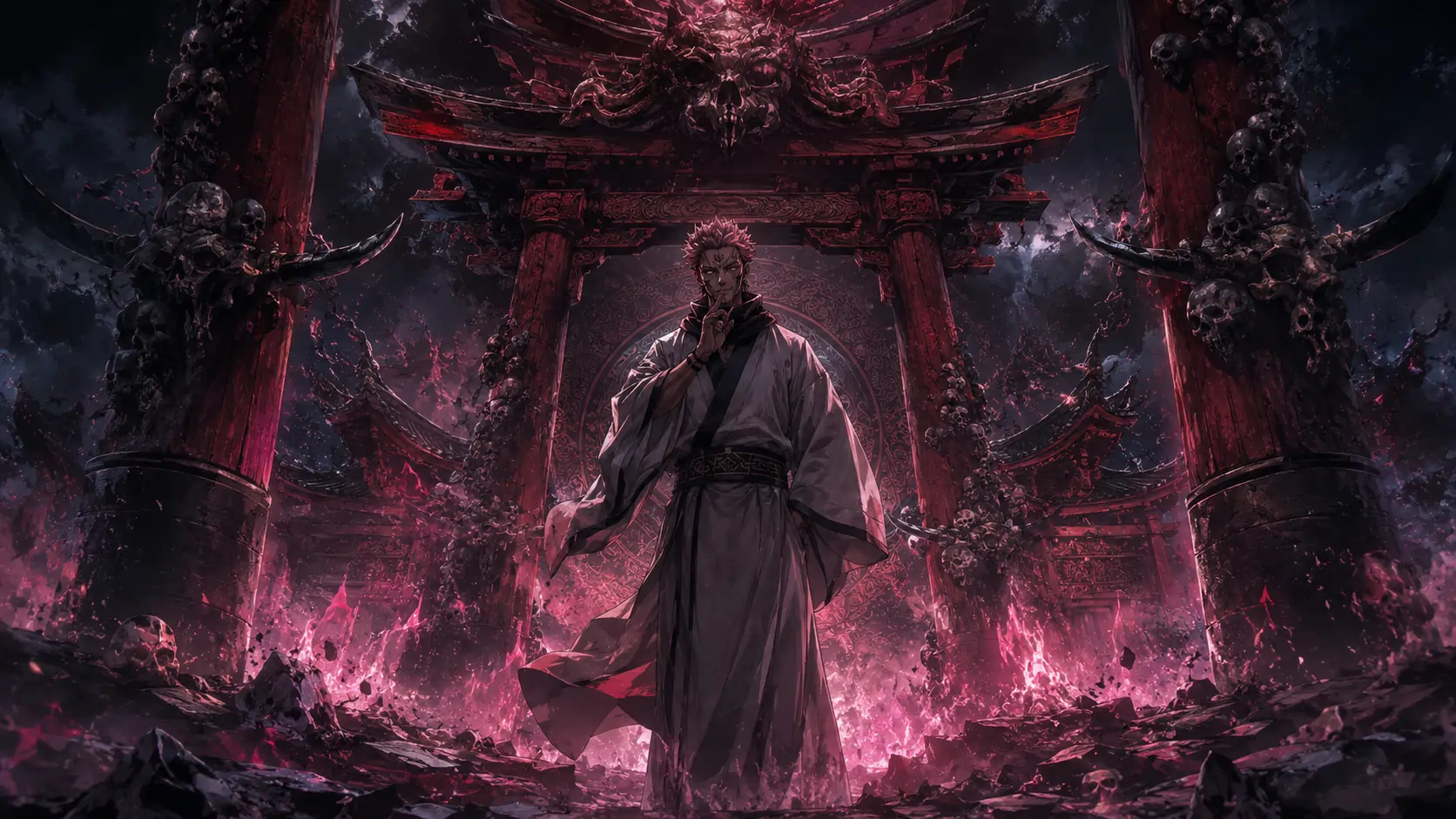
Sukuna’s domain is not just a technique — it’s a death sentence wrapped in pink flames. Every time Ryomen Sukuna activates his domain expansion, the air changes. Fighters freeze. Survival odds drop to near zero. If you’ve watched the Gojo vs. Sukuna domain clash and wondered exactly what makes this technique so terrifying, you’re in the right place. This article breaks it all down — the mechanics, hand signs, real power, and why no domain in Jujutsu Kaisen compares.
What Is Sukuna Domain Expansion?
Sukuna’s domain expansion is called Malevolent Shrine (Jōkoku Mandara). It works differently from every other domain in the series. Most sorcerers build a closed barrier — a separate space where their cursed technique becomes absolute. Sukuna does the opposite.
Malevolent Shrine expands into reality itself. It doesn’t close off the outside world. Instead, it overlays the real world with Sukuna’s innate domain, filling the existing space with his territory. This is a critical distinction. It means Sukuna’s domain is harder to counter, harder to escape, and far more powerful in range than a standard bounded field.
Inside Malevolent Shrine, two passive effects activate automatically:
- Slicing — objects, structures, and living beings within range are continuously cut apart at the cellular level.
- Cleaving — anything with cursed energy or life force is destroyed in proportion to that energy.
The domain hits everything in a radius of roughly 200 meters. No one inside that radius survives without an extremely precise barrier technique.
The Shrine Itself: What Does It Look Like?
The visual design of Malevolent Shrine draws from Buddhist and Hindu iconography — specifically the mandala structure used in tantric traditions. The “shrine” appears as a massive, ornate wooden structure surrounded by skulls, horns, and ox-like imagery. Pink and black flames burn across its surface.
This isn’t decorative. The imagery signals Sukuna’s dual nature — the god of calamity and the cursed king — and ties directly into how his cursed technique functions. His curse reflects divine destruction rather than human fear, which is rare among sorcerers. Most cursed spirits and humans draw from human trauma. Sukuna draws from something older.
Sukuna Domain Expansion Hand Sign: What Gesture Does He Use?
The sukuna domain expansion hand sign is one of the most replicated gestures by fans of the series. In the anime and manga, Sukuna uses a specific mudra — a ritual hand position — before the domain fully activates.
His primary hand sign involves:
- Fingers interlocked with pointed index fingers
- Thumbs crossed or pressed together
- A deliberate, slow formation that signals the technique is intentional and controlled
This mirrors real-world tantric mudras used in Buddhist ritual practice. The hand sign isn’t just visual flair — within the Jujutsu Kaisen world, the hand sign is part of the cursed energy flow required to shape the domain’s boundary condition.
Unlike many sorcerers who require complex vocal incantations, Sukuna’s domain can be activated with minimal outward signal. That’s part of what makes him so dangerous. By the time an opponent recognizes the hand sign, the domain is already forming.
How Malevolent Shrine Differs From Every Other Domain
Here is a direct comparison of Malevolent Shrine against standard domain expansion techniques used by other sorcerers in Jujutsu Kaisen:
| Feature | Standard Domain | Malevolent Shrine |
|---|---|---|
| Barrier Type | Closed (separate space) | Open (overlays reality) |
| Activation Speed | Moderate | Extremely fast |
| Counter: Barrier Technique | Yes, effective | Partially effective only |
| Range | Limited to barrier size | Up to 200m radius |
| Sure-Hit Condition | Inside barrier | Inside radius |
| Visual Signature | Unique per user | Buddhist shrine, skulls, flames |
| Weakness | Barrier can be pierced | Requires enormous cursed energy |
| Energy Cost | High | Exceptionally high |
The open-barrier design is the key innovation. When Gojo used Unlimited Void against Sukuna, it was a closed-barrier domain with a guaranteed sure-hit condition. Sukuna’s response — deploying Malevolent Shrine in an open format — meant no closed counter-barrier could fully neutralize it. The two domains clashing created one of the most technically complex fights in shonen manga history.
Gojo vs. Sukuna Domain Clash: What Actually Happened?
The Gojo and Sukuna domain clash is the most analyzed fight in Jujutsu Kaisen. Understanding it requires knowing the rules first.
When two domains clash, the stronger domain — measured by output, precision, and cursed energy volume — overwhelms the weaker one. The weaker domain collapses first, leaving its user exposed to the surviving domain’s sure-hit effect.
In the Gojo vs. Sukuna domain clash, here is the sequence:
- Gojo activates Unlimited Void — his closed domain traps everything inside in an infinite sensory loop, effectively shutting down the target’s ability to think or act.
- Sukuna counters with Malevolent Shrine — rather than matching Gojo’s closed domain, Sukuna deploys an open domain that physically destroys the surrounding area.
- Domain clash sustained — both sorcerers maintain their domains simultaneously. This is extraordinarily rare. Most sorcerers cannot hold a domain long enough to sustain a clash.
- Sukuna’s refinement wins — Sukuna had spent centuries refining Malevolent Shrine. Gojo had never faced a genuine peer in domain clash duration. Sukuna’s output eventually exceeded Gojo’s sustained maximum.
The result shocked readers and viewers because Satoru Gojo — established as the strongest sorcerer alive — was defeated. Not by power alone, but by the precision and endurance of Sukuna’s domain compared to Gojo’s.
This is why the gojo vs. sukuna domain expansion outcome is controversial. It wasn’t that Gojo’s technique was weaker in theory. Sukuna’s real-world mastery had no ceiling.
Sukuna’s Cursed Technique and How It Fuels the Domain
Sukuna’s innate cursed technique involves slashing cuts and fire manipulation. His fire takes the form of Cleave (proportional destruction based on cursed energy) and Dismantle (fixed-output slicing against non-cursed objects). These two abilities are directly embedded into Malevolent Shrine’s passive effects.
This is what makes his domain so lethal even without the sure-hit condition. Every second spent inside Malevolent Shrine, targets receive:
- Continuous Dismantle slicing from every direction
- Cleave applying destructive force proportional to their power level
Stronger sorcerers actually take more damage from Cleave because the technique scales with cursed energy output. Fighting harder makes you die faster inside Sukuna’s domain. That design is uniquely cruel — and uniquely Sukuna.
Can Sukuna’s Domain Be Escaped or Countered?
Yes — but the options are narrow and demand elite-level skill.
Simple Domain is the most effective counter for lower-level sorcerers. This is a small, personal domain that neutralizes the sure-hit condition of any larger domain. It doesn’t stop the physical destruction, but it prevents the automatic guaranteed-hit effect from landing.
Domain Amplification wraps a sorcerer’s body in their cursed technique, neutralizing cursed technique effects that touch them. This counters the sure-hit condition directly.
Barrier Manipulation at an advanced level — as seen with Hana Kurusu’s Jacob’s Ladder — can pierce a domain entirely.
The challenge is execution. Deploying a simple domain mid-fight against Sukuna means spending cursed energy on defense while Malevolent Shrine actively destroys everything around you. Most sorcerers don’t survive long enough to deploy the counter correctly.
Why Sukuna Is Considered the Strongest Cursed Spirit
Ryomen Sukuna is not classified as a cursed spirit by most characters in the series — he’s categorized as a special-grade cursed object, and later as a reincarnated human sorcerer. This distinction matters.
Cursed spirits form from human fear and negative emotion. Their cursed techniques reflect that. Sukuna’s technique reflects something pre-human — violence, calamity, and destruction at a scale that predates recorded sorcery. His domain draws from a different source of power than any other character in the series.
This is supported by the fact that Sukuna’s fingers — 20 in total — each carry enough cursed energy to classify as a special-grade cursed object independently. His full 20-finger form, shown later in the manga, demonstrates power that overwhelms multiple special-grade sorcerers simultaneously.
Malevolent Shrine at full power in this form has a range exceeding 200 meters. Everything inside that radius is cut and cleaved without pause.
The Role of Megumi’s Ten Shadows in Sukuna’s Power
During the Shibuya arc and beyond, Sukuna gains access to Megumi Fushiguro’s Ten Shadows Technique. This is significant because it allows Sukuna to potentially combine Malevolent Shrine with shikigami-based strategies that Megumi had never fully unlocked himself.
The Ten Shadows Technique creates and controls divine shikigami through shadow manipulation. Sukuna, possessing Megumi’s body, exploits this technique to summon Mahoraga — a shikigami considered impossible to control — and weaponize it in ways Megumi never could.
This combination of Malevolent Shrine (raw destruction) and Ten Shadows (adaptive shikigami) makes Sukuna’s threat level uniquely layered. He doesn’t rely on one technique. He stacks domain-level destruction with summoning-level versatility.
Sukuna’s Domain vs. Other Top-Tier Domains in Jujutsu Kaisen
Let’s place Malevolent Shrine against the other highest-ranked domain expansions in the series:
| Domain | User | Type | Sure-Hit Method | Weakness |
|---|---|---|---|---|
| Malevolent Shrine | Sukuna | Open | Passive slicing/cleaving | Enormous energy cost |
| Unlimited Void | Gojo Satoru | Closed | Infinite sensory overload | Barrier can be countered |
| Coffin of the Iron Mountain | Jogo | Closed | Extreme heat within barrier | Low refinement vs. top-tier |
| Self-Embodiment of Perfection | Mahito | Closed | Idle Transfiguration touch | Sure-hit neutralized by simple domain |
| Chimera Shadow Garden | Megumi | Incomplete Closed | Shadow flooding | User lacks full control |
Malevolent Shrine ranks highest in raw destructive output and range. Unlimited Void ranks highest in sure-hit reliability against unprepared targets. Against each other, the outcome comes down to endurance and refinement — which is exactly what the Gojo vs. Sukuna domain expansion fight proved.
Key Entities and Concepts Related to Sukuna’s Domain
Understanding Sukuna’s domain fully means knowing the surrounding framework of Jujutsu Kaisen world-building. Here are the key entities that connect directly:
- Ryomen Sukuna — the King of Curses, original owner of Malevolent Shrine
- Yuji Itadori — Sukuna’s host during most of the series
- Megumi Fushiguro — whose body Sukuna later occupies
- Satoru Gojo — the only sorcerer to clash domains with Sukuna and sustain the clash
- Jujutsu High (Tokyo Metropolitan Curse Technical College) — the institution training sorcerers who face Sukuna
- Kenjaku — the manipulator whose scheming indirectly leads to Sukuna’s full reincarnation
- Mahoraga — the divine shikigami Sukuna weaponizes through Ten Shadows
What Fans Get Wrong About Sukuna’s Domain
A common misconception is that Malevolent Shrine’s open structure means it has no sure-hit condition. That’s not accurate.
The sure-hit condition for Malevolent Shrine is simply different. In a closed domain, the sure-hit lands because the environment guarantees the technique reaches the target. In Malevolent Shrine, the sure-hit is built into the passive slicing effect — Dismantle and Cleave hit everything in range automatically, without Sukuna needing to aim. The “guarantee” is spatial rather than barrier-based.
Another misconception: that Sukuna needed Gojo to be weakened before the domain clash. The manga and supplementary material from series creator Gege Akutami confirm that Sukuna at 20 fingers was simply stronger in domain output than Gojo in sustained clash conditions. The fight outcome was about peak output over time, not a weakened Gojo.
FAQs About Sukuna’s Domain Expansion
Q: What is Sukuna’s domain expansion called?
Sukuna’s domain expansion is called Malevolent Shrine (Jōkoku Mandara). It is an open-barrier domain that overlays reality with Sukuna’s cursed territory, activating passive slicing and cleaving effects across a radius of approximately 200 meters.
Q: What are the sukuna domain expansion hand signs?
Sukuna uses a mudra-style hand sign — fingers interlocked with pointed index fingers and crossed thumbs. This mirrors real Buddhist tantric mudras. The hand sign channels cursed energy flow required to shape the domain’s open boundary condition before full activation.
Q: Why did Sukuna beat Gojo in the domain clash?
In the gojo vs. sukuna domain clash, Sukuna’s centuries of domain refinement gave his Malevolent Shrine greater sustained output than Gojo’s Unlimited Void. Gojo had never faced a peer capable of holding a domain clash long enough to force a collapse. Sukuna outlasted him in raw domain endurance.
Q: Can Sukuna’s domain be countered?
Yes. Simple Domain neutralizes the sure-hit condition. Domain Amplification provides body-level protection. Advanced barrier manipulation can pierce the domain entirely. However, executing any of these counters inside Malevolent Shrine’s 200-meter radius under active destruction pressure requires elite-level skill and near-perfect timing.
Q: How many times does Sukuna use his domain in the series?
Sukuna activates Malevolent Shrine multiple times across the manga and anime — most notably during the Shibuya Incident, the Gojo fight in the Shinjuku Showdown arc, and in various battles during his full 20-finger reincarnation. Each activation demonstrates increasing refinement and range.
Q: Is Malevolent Shrine the strongest domain in Jujutsu Kaisen?
In terms of raw destructive output and spatial range, yes — Malevolent Shrine is the strongest domain shown in Jujutsu Kaisen to date. Unlimited Void is more reliable in sure-hit efficiency against unprepared targets, but Malevolent Shrine’s open structure and passive destruction effects give it an edge in sustained domain-clash scenarios.
Final Take: Why Sukuna’s Domain Defines the Series
Sukuna’s domain isn’t just powerful — it reframes what power means in Jujutsu Kaisen. Every other domain in the series closes off a space and controls it. Sukuna absorbs the real world into his domain and destroys it from within.
That difference in approach reflects Sukuna’s character: he doesn’t retreat into a safe space to win. He turns your world into his battlefield.
The Gojo and Sukuna domain clash wasn’t just a fight scene. It was the series proving that even the most gifted sorcerer alive has a ceiling — and that Sukuna, shaped over a thousand years of violence, had refined his technique past any ceiling Gojo had ever needed to face.
If you want to go deeper into domain expansion mechanics, cursed technique analysis, or the full breakdown of Sukuna’s 20-finger power scaling, explore the Jujutsu Kaisen official manga by Gege Akutami published through Shueisha’s Weekly Shōnen Jump, the Jujutsu Kaisen Official Fanbook, or the animated adaptation produced by MAPPA Studio.
Sources referenced for accuracy and world-building context:
- Gege Akutami — Jujutsu Kaisen manga, Shueisha (Weekly Shōnen Jump)
- Jujutsu Kaisen Official Fanbook — Shueisha, character and technique data
- MAPPA Studio — Jujutsu Kaisen Season 2 & Season 3 anime adaptation
- Fandom Wiki — Jujutsu Kaisen (cross-referenced for technique naming conventions only)
- Buddhist mudra symbolism — Encyclopedia of Religion, Mircea Eliade (for iconographic context)