The Best Absolute Scarecrow System to Finally Keep Birds Away
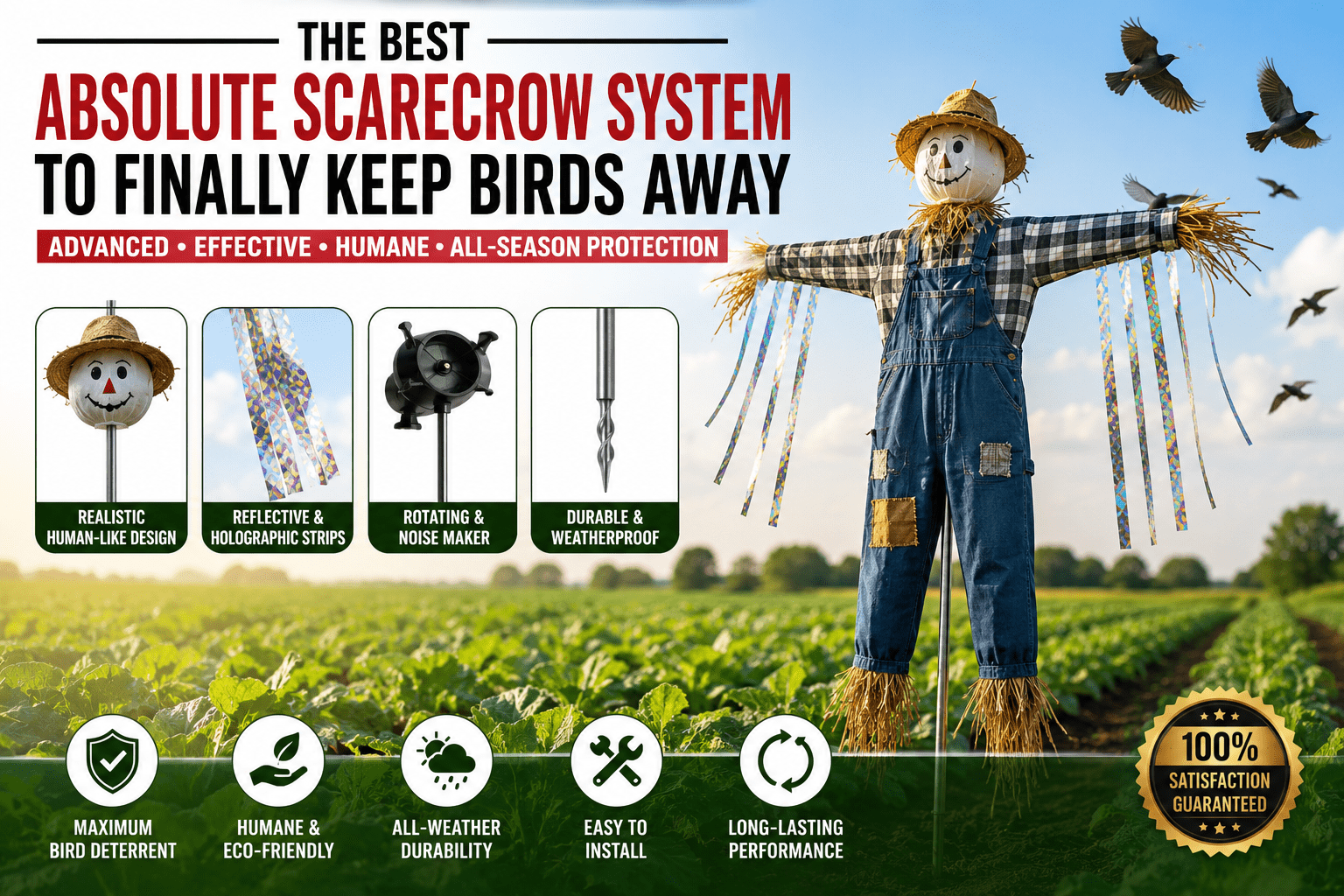
How to Build an Absolute Scarecrow System That Actually Keeps Birds Away
You spent months nurturing your garden. You watered it through heat waves, staked the tomatoes, thinned the seedlings — and then, one morning, you walked outside to find it half destroyed. Pecked fruits. Stolen seeds. Bare stalks where rows of crops used to be.
If that sounds familiar, you already know that the old stuffed shirt on a stick isn’t doing its job.
This guide walks you through a smarter approach: building a layered bird deterrent system that draws on how birds actually think and behave — not just how we imagine they do.
Why Birds Stop Fearing Traditional Scarecrows
Birds are far more observant than most gardeners give them credit for. A crow or starling will watch a stationary figure for a day or two before concluding it poses no threat. Pigeons are even bolder — they’ll roost on top of a scarecrow if it doesn’t move.
The problem isn’t the concept. It’s the execution.
A figure that never changes, never makes a sound, and never reacts to a bird’s presence is, from the bird’s perspective, just another piece of the landscape. Once a bird “classifies” your scarecrow as safe, that mental note sticks. The entire flock learns from the first brave individual.
This is called habituation, and it’s the primary reason single-method deterrents fail within a week or two.
What Makes a Bird Deterrent System Actually Work
Effective bird control isn’t about one scary thing — it’s about unpredictability. Birds avoid areas where they can’t accurately assess the level of danger. When multiple things are happening at once, and when those things change over time, birds don’t feel safe enough to commit to landing.
A well-designed system targets at least three of a bird’s primary senses:
- Sight — movement and visual signals that suggest a predator is present
- Sound — sudden or irregular noises that break the silence
- Physical sensation — contact or near-contact that triggers the flight response
Below is how to layer each element effectively.
Visual Deterrents That Go Beyond a Stuffed Shirt
Reflective Materials
Birds have four types of color receptors (humans have three), which means they perceive light and reflections far more vividly than we do. Flashing or iridescent materials are genuinely disorienting to them.
Effective options include:
- Reflective tape — run strips between stakes at varying heights so they catch wind and twist unpredictably
- Old compact discs — hang them from strings so they spin and scatter light in multiple directions
- Mirror-finish pinwheels — these combine movement with reflection, doubling the deterrent effect
- Predator eye balloons — large inflatable spheres printed with owl eyes; most effective when moved to a new location every few days
The key word is movement. A static reflective surface loses its effect almost as quickly as a static figure.
Silhouette Decoys
Hawk and owl silhouettes — whether three-dimensional decoys or flat cutouts — can work well in the short term. They’re most effective when hung so they swing freely in the wind, creating the impression of a hovering predator.
If you use a three-dimensional owl decoy, move it daily. Birds will accept a motionless owl in the same tree for three days before deciding it’s not real.
Sound-Based Deterrents
What Works and What Doesn’t
Continuous noise actually backfires — birds habituate to constant sound just as readily as they do to static visual cues. What disrupts them is irregular sound: something that starts and stops unpredictably.
Options worth considering:
Wind chimes — low-cost and reasonably effective in areas with consistent wind; less useful in still conditions
Propane cannons — the standard in commercial farming; they fire loud percussive blasts at random intervals; effective but likely inappropriate for residential neighborhoods
Distress call speakers — devices that play recorded distress or alarm calls from the same species you’re trying to deter; these can be highly effective because they target species-specific instincts, though some birds learn to ignore them over time
Ultrasonic emitters — emit frequencies above human hearing that birds find uncomfortable; most effective in enclosed or semi-enclosed spaces; less consistent in open garden settings
For home gardens, a combination of wind chimes plus an occasional distress call speaker offers a reasonable balance between effectiveness and neighbor relations.
Motion Sensors: The Element That Changes Everything
If there’s one upgrade that dramatically improves any bird deterrent setup, it’s adding motion-activated response.
Motion-Activated Sprinklers
Devices like the Orbit Yard Enforcer or similar products detect movement with an infrared sensor and fire a short burst of water. This mimics what birds experience when a predator lunges — sudden, physical, and coming from an unexpected direction.
Birds don’t just leave; they tend to avoid the area for days afterward. The association between that location and a frightening physical sensation is strong.
Place these units facing the direction birds typically approach, and angle them to cover the most vulnerable parts of your garden.
Motion-Activated Sound
Some deterrent devices combine a PIR sensor with recorded predator calls or sharp alarm sounds. The sudden audio response when a bird lands nearby is significantly more startling than continuous background noise.
Placement: The Part Most People Get Wrong
A deterrent system that isn’t visible from a bird’s approach path won’t interrupt the approach. Birds scan from above before landing, so placement has to account for the aerial view.
General principles:
- Position the tallest elements at the center of your garden or slightly elevated — birds spot movement from height
- Cover the cardinal approach directions; most flocks return from the same general direction each morning
- Protect the highest-value crops first (tomatoes, berries, corn) before worrying about the perimeter
- Avoid placing everything in one cluster; spread deterrents across the space so there’s no “safe” corner
A simple layout that works:
- Two reflective tape lines running north-south and east-west, creating an X pattern across the garden
- A motion-activated sprinkler facing the primary approach angle
- A predator decoy (owl or hawk) suspended from a stake so it moves freely
- Rotating the decoy’s position every 48–72 hours
This layout doesn’t require significant investment and covers the three core deterrent categories.
Rotating and Refreshing Your Setup
No system remains effective indefinitely if it stays identical. Birds have excellent spatial memory and will eventually map out which elements move and which don’t.
Practical rotation schedule:
| Task | Frequency |
|---|---|
| Move predator decoys | Every 2–3 days |
| Reposition reflective tape lines | Once a week |
| Check batteries on electronic devices | Every 2 weeks |
| Refresh or replace faded materials | Monthly |
| Change sprinkler position | Every 10–14 days |
The rotation doesn’t need to be dramatic — even a meter in any direction resets a bird’s threat assessment of the object.
DIY Absolute Scarecrow: A Build That Actually Moves
If you want to build a physical scarecrow that’s more effective than the traditional design, here’s a version that incorporates movement mechanics.
Materials:
- 1.5-inch PVC pipe (vertical stake) and a T-junction at the top for arms
- Lightweight mylar fabric or emergency blanket cut into strips and attached to the arm ends
- A second shorter section of PVC for the head, attached via a loose coupling so it rotates in wind
- Old CDs or mirror tiles hung from the arm ends on fishing line
The loose coupling at the neck joint is the critical feature. When wind moves through the garden, the head rotates rather than remaining fixed — giving the figure the appearance of looking around. The mylar strips shimmer and shift with even light breezes.
This design is weather-resistant, costs under $30 to build, and outperforms a traditional straw figure significantly.
Comparing Your Options at a Glance
| Deterrent Type | Effectiveness | Cost | Maintenance |
|---|---|---|---|
| Traditional straw figure | Low — habituated within days | Minimal | Low |
| Reflective tape + pinwheels | Moderate | Low | Low-medium |
| Predator decoys (static) | Low-moderate | Low-medium | Low |
| Predator decoys (moved regularly) | Moderate-high | Low-medium | Medium |
| Motion-activated sprinkler | High | Medium | Low |
| Distress call speaker | High | Medium | Low-medium |
| Layered multi-sensory system | Very high | Medium | Medium |
A Note on What Science Supports
Research from the Cornell Lab of Ornithology and studies referenced in USDA Wildlife Damage Management guidelines consistently point to the same conclusion: no single deterrent method provides lasting results. What works is integration — combining visual, auditory, and physical deterrents in ways that prevent habituation.
This is also in line with Integrated Pest Management principles, which emphasize using multiple, complementary approaches rather than escalating a single method.
If one element of your setup isn’t working, the answer usually isn’t a stronger version of the same thing — it’s adding a different category of deterrent altogether.
Frequently Asked Questions
How long before birds give up on my garden entirely?
Consistent deterrence over two to three weeks typically causes birds to reroute their foraging path. Persistence through the initial period — when birds are still testing your defenses — is the most important factor.
Do these methods work on small birds like sparrows or finches?
Yes, though small birds can be quicker to habituate than larger species. Ultrasonic devices and motion-activated sprinklers tend to work well across a range of sizes.
Is there anything I should avoid doing?
Avoid using netting as your only defense — birds can get trapped and injured. Also avoid leaving deterrents completely unchanged for more than a week; consistency of change is what makes the system work.
Can I combine a physical scarecrow with electronic deterrents?
Absolutely, and that combination is generally more effective than either alone. The physical figure provides a continuous visual presence while electronic elements provide unpredictable stimulus.
Do these systems work year-round?
In most climates, yes, though your most intensive use will probably be during planting season and harvest. Solar-powered electronic devices can continue running through winter without battery replacement concerns.
Final Thought
The goal isn’t to build a scarier scarecrow. It’s to make your garden feel genuinely unpredictable and mildly dangerous to any bird that approaches. That requires layering elements, rotating them consistently, and never letting the setup go stale.
A garden that fights back — even a little — gets left alone.